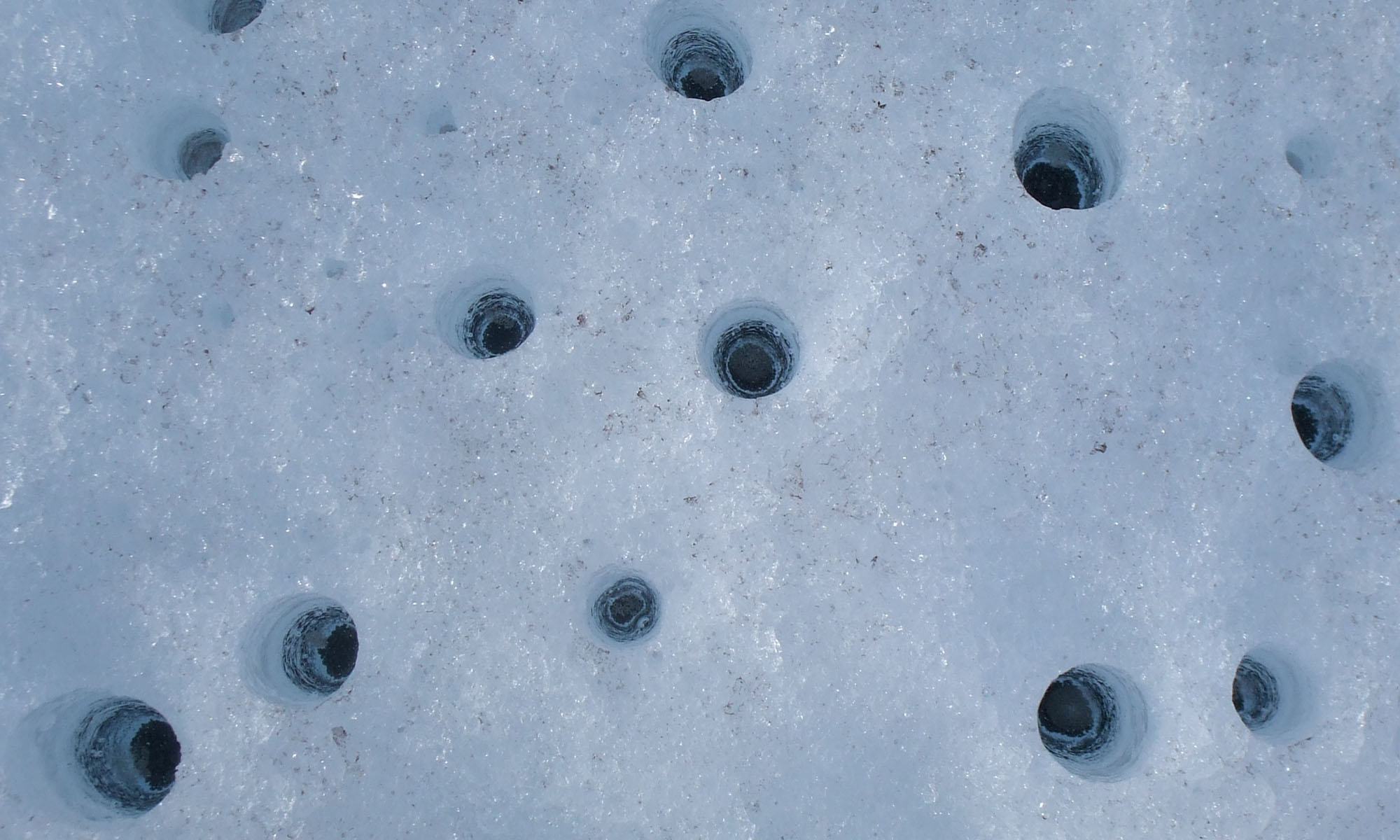
specific content
- images of all cryoconite lifeforms, particularly in cryoconite holes; differences between them
- maps of wind patterns which distribute the dust which form part of cryoconite deposits; cryoconite distribution map
- time-lapse of cryoconite hole formation
- image of many cryoconite holes PSd to cover large area
practical
- current existence of digital and physical assets, including actual ice cores?
get very high resolution images of cryoconite holes - where are nearest cryoconite holes or cheapest to get to?
physical and biological
- why do some cryoconite deposits, or aggregations, lead to discrete holes? but others observed as surface coatings?
- how old are extant cryoconite holes?
- how long does it take for a distinct cryoconite hole to form?
- how long does a cryoconite hole last in its distinct form?
- why are cryoconite holes circular?
- depth / width proportion; variations in size of cryoconite holes
- why do cryoconite holes form at a particular points, and why do they seem to space themselves efficiently?
- why is there not a concentration of cryoconite around cryoconite holes? – do the people taking the pictures look for the visually best images? maybe – is cryoconite around a cryoconite hole is wind-eroded while the cryoconite in a hole, now protected, remains
- how large a patch of cryoconite to get a hole started?
- local variation in life forms in cryoconite holes? silo effect?
- did cryoconite holes exist before anthropogenic atmospheric particles / soot – volcanic dust; how did they differ
- assume that cryoconite deposits, and subsequent cryoconite holes, have existed as long as there have been ice sheets and glaciers: particles from wind-bourne earth erosion, volcanic eruption, …
- glaciers are described as receding, but probably melt where they stand, so the nose / snout is only seen as going backwards; position of a cryoconite hole may still be going forward as the glacier melts, because still being built at its iceshed (does that word exist as an analogue to watershed?)
meaning and culture
- microcosm of climate change? some benefit, most do not; subtle, nuanced, ambivalent
- correspondence between emergence of stable ecosystems in cryoconite holes and first emergence of life on Earth, or wherever it first emerged?
- the idea of cryoconite holes as human made writing instruments making invisible radioactive marks, record of what humankind has done
- what did and do polar-dwelling people think of these cryoconite holes? weird? useful reindeer and dog drinking holes?
climate change
- some people – some very powerful or influential – seem to think they are entitled to make personal judgements about climate change
- rigour: quantitative as well as meditative
- get people interested in holes: ice holes
- tell a complex story, successive stories, parallel stories
- data art; didactic intention
- real time, or simulated, environmental changes: glacier recession, …
- gallery of organisms: rotifers, tardegrades, cyanobacteria, … copepod; Plecoptera spp; the tardigrade Pilatobius recamieri
- use as an example of the complexity of the natural world, the complexity of climate change, the detail and beauty of small unknown systems and the paradox of something small, complete and beautiful being also a symptom of …
visual
- cryosonite holes are striking visually but not completely visually unique in nature … sort of opposites of full moon, full solar eclipse, the sun, the pre- space flight never seen earth; … eyes, bubbles
- … black holes visualised; volcanoes; sinkholes; whirlpools; ice circles; atolls; crop circles
- … things made by humans and other animals
- but how many cryoconite holes are perfectly circular? or are circular ones disproportionately photographed because glaciologists like the perfect ones … is this a metaphor, people prefer things which appear ordered
at the macroscopic level; it is life which gives the appearance of order and perfection, non-living things tend to be messier - people correct fairly circular things in their memories to be more perfectly circular
quotations
- Everything in nature takes its form from the sphere, the cone and the cylinder. – Paul Cézanne … also circle, spiral, disc – disc not necessarily a shallow cylinder, could be lenticular – but you can see his point
- I choose to convey the beauty as opposed to the devastation, in order to empower viewers rather than frighten them. If you can experience the sublimity of these landscapes, perhaps you will be inspired to protect and preserve them. – Zaria Forman – www.artstar.com/collections/zaria-forman – … but if what if a thing which is a symptom of and is a cause of the harm is in itself beautiful? … just as flying to the other side of the world can take you to the beautiful and unusual,, but also help to destroy them … Maldives, Seychelles, other places with round atolls