Project acronym: GRASP
Project title: Glacier Recession as a Source of Environmental Pollutants
Project leader: Caroline Clason, Plymouth University, UK
Discipline: Earth Sciences & Environment
Station(s): Tarfala Research Station (Sweden)
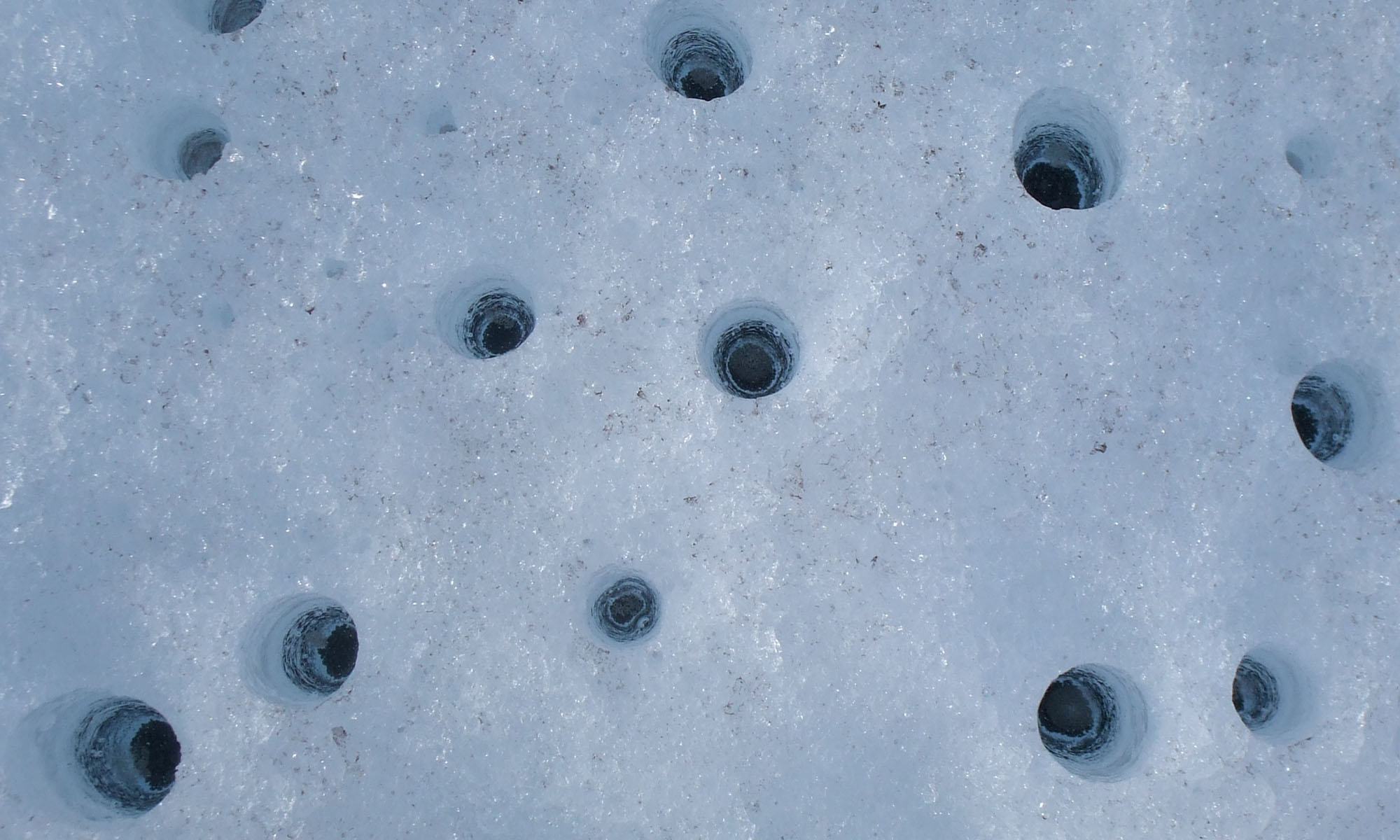
Glaciers act as stores for products that fall onto their surface, and snow has been shown to be an efficient scavenger of trace elements from the atmosphere. Glaciers may thus act as a reservoir, storing and releasing potentially high concentrations of pollutants into waterways. During August 2017 we conducted sampling on and in front of Isfallsglaciären in the Tarfala Valley of Arctic Sweden. Isfallsglaciären is a small polythermal glacier which has been steadily retreating over the last century, with meltwater and sediments released from the glacier collecting in two proglacial lakes (Frontsjön and Isfallssjön) situated within 700 m of the present-day glacier terminus. The region received fallout from the Chernobyl nuclear accident, offering an important marker to test the hypothesis of contaminant concentration in the glacier system, both through interaction with cryoconite and other glacial sediments. Our research was thus designed to investigate changes in water and fine-sediment quality in the Isfallsglaciären catchment, in response to time-varying inputs of inorganic atmospheric pollutants. Our field campaign, based at Tarfala Research Station, included sampling of sediments on, marginal to, and in front of Isfallsglaciären, as well as in the proglacial meltwater streams, in order to evaluate the relative contribution of different sources to sediment contamination. The samples we collected were dried and split into fine and bulk components in preparation for transport back to the UK and subsequent geochemical analysis. Having now returned from the field, we have begun analysing the samples for fallout radionuclides (FRN) and naturally occurring radioactive elements by gamma spectrometry, and a full suite of major and minor elements by wavelength-dispersive X-Ray fluorescence (WD-XRF) in the Plymouth University Consolidated Radioisotope Facility. During our time at Tarfala we also collected a 38 cm long sediment core from the Isfallsjön proglacial lake using an HTH gravity corer. The core will be used to construct a timeline for sediment accumulation and contamination in the catchment, and will be analysed for FRN markers, including excess Pb-210, and Cs-137 from 1960s weapons testing and the Chernobyl nuclear accident. The ultimate goal of our work is to determine whether inorganic atmospheric pollutants are concentrated through capture by snowfall and interaction with glacial sediments including cryoconite, and to investigate whether contaminants released from Isfallsglaciären through melting are enriched in fine sediment to levels that are potentially harmful to the environment or for human consumption. This research will provide an important insight into the potential vulnerability of pristine Arctic environments to contaminant-enriched sediments released from glaciers as they continue to retreat in response to a warming climate.
original document PDF in new tab or page